How to spot a fake delivery text
Fake parcel delivery texts are the most common scam text in the UK. Here is how to tell a real one from a fake, and what to do if you're not sure.
You're expecting a parcel. A text arrives claiming there's been a problem with your delivery - a missed attempt, a customs fee, a redelivery that needs booking. It has a link.
This is the most common scam text in the UK. Fake delivery notifications account for a significant share of all smishing reports, and they work because they arrive at the right moment - when you really are expecting something.
Here is how to tell the real ones from the fake ones.
Why fake delivery texts are so effective
Several things make this scam unusually convincing:
- Timing - with online shopping at record levels, most people have at least one parcel in transit at any given time. A delivery text always feels plausible.
- Real companies do send texts - Royal Mail, Evri, DPD, DHL, Amazon, and others genuinely notify customers by SMS. Scammers exploit the fact that the format is familiar.
- Small amounts feel low-stakes - requests for £1.50 to £2.99 for a "customs fee" or "redelivery charge" feel trivial. But the goal is your card details, not the fee itself.
- Urgency - "Delivery attempt failed", "Item held at depot", "Pay within 24 hours" - these prompts trigger action before thought.
What fake delivery texts look like
The most common variants:
Customs or import fee due
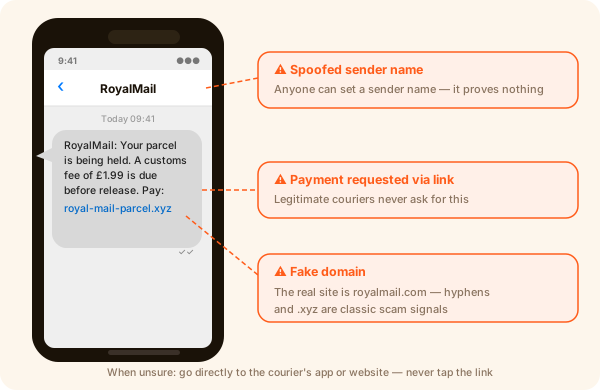
"Your parcel is being held. A customs fee of £1.99 is due before we can release it. Pay here: [link]"
Failed delivery attempt
"We attempted to deliver your parcel today. Rebook your delivery here: [link]"
Address confirmation required
"Your delivery failed because your address could not be confirmed. Update your details: [link]"
Delivery scheduled - action required
"Your parcel will be delivered tomorrow. Confirm your slot here to avoid return: [link]"
All of these follow the same pattern: create a small problem, offer a simple solution, provide a link.
How to spot a fake
Check the sender
Real delivery companies send texts from recognisable shortcodes or named sender IDs - "RoyalMail", "Evri", "DPD". Fake texts often come from random mobile numbers or generic shortcodes that don't match the company.
That said, scammers can spoof sender IDs, so a convincing sender name is not a guarantee.
Read the link carefully
Before tapping anything, look at the URL. Real delivery companies use their own domains:
- Royal Mail:
royalmail.com - Evri:
evri.com - DPD:
dpd.co.uk - DHL:
dhl.com - Amazon:
amazon.co.uk
Fake links use variations designed to look right at a glance: royal-mail-delivery.com, evri-redelivery.net, dpd-uk-parcel.com. On a small screen, these are easy to miss. For a full guide to reading URLs, see how to tell if a link is safe before you click it.
Look for a tracking number
Genuine delivery notifications almost always include your tracking number or order reference. A text that asks you to take action but provides no way to verify which parcel it refers to is a strong warning sign.
Watch for payment requests
This is the most reliable tell. Legitimate delivery companies do not ask for payment via a link in a text message. Royal Mail customs charges are handled through a different process - you'll receive a physical card or access the Royal Mail portal through the official app. If a text asks for card details to release a parcel, it is a scam.
What to do when you receive one
Don't tap the link. If you're unsure whether a delivery notification is real, go directly to the courier's official website or app - type the address yourself - and enter your tracking number there. If there's a genuine issue, it will show up.
Check the link. Copy the URL from the text (press and hold the link, then select Copy) and paste it into SniffTest. It runs multiple checks including domain age, phishing blocklists, and brand impersonation detection, and returns a plain-English verdict before you visit anything.
Report it. Forward the text to 7726 (free on all UK networks). This goes directly to your mobile network's fraud team. You can also report to Action Fraud at actionfraud.police.uk.
Delete it. Once reported, delete the message. Keeping it around means you might tap the link later by accident.
If you already clicked and entered card details
Call your bank immediately using the number on the back of your card. Ask them to:
- Cancel or freeze the compromised card
- Monitor your account for fraudulent transactions
- Reverse any charges if fraud has already occurred
File a report with Action Fraud at actionfraud.police.uk - you'll receive a reference number which may be useful when dealing with your bank.
For the full recovery guide covering passwords, personal data, and malware scenarios, see what to do after clicking a phishing link.
How to tell a real delivery text from a fake one - at a glance
| Signal | Real | Fake |
|---|---|---|
| Includes tracking number | Usually ✅ | Rarely |
| Link goes to official domain | ✅ | ❌ |
| Asks for card payment via link | Never | Often |
| Sender matches the company | Usually | Sometimes (spoofed) |
| Creates urgency to pay | Rarely | Almost always |
Frequently asked questions
Q: Does Royal Mail charge customs fees by text?
A: No. Royal Mail does send customs fee notifications, but not in a way that asks for card payment via a link in a text. Genuine customs charges are communicated via a physical card through your letterbox, or through the Royal Mail app and official website. Any text claiming to be from Royal Mail asking for card details is a scam.
Q: How can I check if a delivery text is real without clicking the link?
A: Go directly to the courier's official website or app and enter your tracking number. If there's a genuine issue, it will appear there. Alternatively, copy the link from the text and paste it into SniffTest - it will tell you whether the destination is a known phishing site before you visit it.
Q: I entered my card details on a fake delivery site. What now?
A: Call your bank immediately on the number on the back of your card. Ask them to cancel the card and monitor for fraud. The sooner you call, the better your chances of recovering any money lost. Also report the scam to Action Fraud at actionfraud.police.uk.
Q: Can scammers fake the sender name on a text?
A: Yes. SMS sender ID spoofing is straightforward and scammers routinely fake names like "RoyalMail" or "Evri". A convincing sender name is not proof that a text is genuine - always check the link and look for a tracking number before taking any action.
Q: Why do I keep getting fake delivery texts even when I'm not expecting anything?
A: Fake delivery texts are sent in bulk to thousands of numbers at once. The scammers are not targeting you specifically - they are relying on the fact that enough recipients will be expecting a parcel at any given time to make the attack worthwhile. If you receive one when you're not expecting anything, it's easier to spot as a scam.
Not sure about a link?
Paste it below and we will run our checks for you. It only takes a few seconds, and you do not need an account.
📬 Scam Watch, our free monthly digest on active scams. Subscribe →